Monday, May 5, 2014

Australian free to air TV takes a turn for the worse


Anyone investing in free to air television in Australia today is asking for trouble. Apart from the Seven Network, the sector has been a disaster for investors. This is fundamentally because the people getting paid insane amounts to run these networks are not in touch with the subtle changes that are taking place in society.

At its core, free to air TV is no different from a whole host of industries that have been adversely impacted by technology – newspapers, book stores, stockbroking, the music industry, movie rentals etc.
 
The Australian free to air industry introduced digital television (with far more channels) about six years ago and promoted this heavily as an alternative to pay television. The idea seemed reasonable at the time, but what has been delivered?
 
The digital channels today largely consist of very cheap (and often tasteless) programming. Much of this is sourced from the UK, a country that today makes some truly reprehensible television. What is it with the UK these days? Is their television just a sad reflection of a society that is increasingly losing its way? I don’t know, but many of these programs are so bad that they are basically unwatchable. Even if you had nothing to do and were bored out of your mind, you wouldn’t watch these shows.

Most of the shows I’m talking about would have had no chance of getting on air in Australia prior to the introduction of digital television. They would have been rightly regarded as merde (to borrow a French term). But in the rush for “content”, network management has taken the view that merde will do.

The Nine and Ten networks do not even have enough quality programming for their main channel, let alone digital channels. And this is why both networks are in a financially parlous state. It is also why you will see the same shows repeated ad nauseum (and this is supposed to be about more choice!).

Nine’s fall from grace has been spectacular. A once leading network with plenty of quality programming is now a basket case because of mismanagement on a grand scale and an inability to discern viewing trends. If Nine’s management is worth what they are paid, I’m a monkey’s uncle.

Ten had a brief period in the mid-1990s to early 2000s where it employed a successful strategy of targeting a younger demographic with very popular shows such as Seinfeld (one my favourite shows ever), The Simpsons, Australian Idol and The Panel. However, when these shows either ended or people simply got sick of them, Ten had nothing to replace them with. And so began the slide into irrelevance and financial turmoil.

Then we have the ABC, which runs a national news network based on public service principles from the 1970s. Take the imaginatively titled The Business show on 24 with Ticky Fullarton. This show is not screened on Fridays – why? Does no business news happen on Fridays? The show also has a summer break for over two months. How can this be a serious news network? 

Counter-intuitive as it may seem, the proliferation of very low quality digital channels is actually an enormous boost for alternative platforms (the internet and pay television). This is because it insults the intelligence of many viewers and also naively assumes that quantity is better than quality (which is a patently false assumption).

Many friends and family members tell me that they don’t watch any free to air television at all. Not one minute of it. If so many in my immediate circle don’t watch it, there must be many more in that category too.
 
Advertising on television is a very “hit and miss” affair, 99.9% of people seeing your advertisement will not go out and buy the product. I don’t think I have ever bought a product or service that I saw advertised on television simply because I saw it advertised on television.

How many people actually watch ads these days anyway? As soon as an ad break occurs, most people change the channel, go and do something else or watch recorded programs where they can screen out advertisements. Where do you go when you want to find a product or service? The internet. Which medium targets advertising specifically to your interests? The internet.

Television’s day of reckoning is coming. It will not completely avoid the fate of newspapers, recorded music and book stores.

Personally, I have traded Seven Group Holdings on many occasions (I’ve never made a loss trading it), but I wouldn’t touch Nine or Ten with a barge pole, unless I decide to short them at some stage.

Friday, February 21, 2014

The Copycat World of Hedge Funds

In the world of bookmaking, there always has to be one bookmaking firm that comes out first with the odds on a particular event. Once the odds are visible to other bookmakers, they will invariably copy them, safe in the knowledge that a fair degree of skill went into the formulation of the odds by those leading the field. In fact, taken to its extreme, you don’t actually need any skills as a bookmaker if you are able to quickly copy and adjust your odds based on what your skilled competitors are doing.

Another analogy, when I was in high school, I had two classmates (in mathematics) named Jeff and Peter (not their real names). They were both friends. Jeff was very smart (he went on to become a doctor). Paul wasn’t so bright. For about half a year, Jeff allowed Peter to discretely copy his answers in tests. Jeff got As, Peter got Bs. The teacher eventually woke up to what was going on and separated Jeff and Peter. After this, Jeff continued to get As and Peter got Ds.

Now the world of hedge fund investing is exactly the same as the bookmaking scenario and the story of Jeff and Peter. Of the thousands of funds out there, very few are truly skilled. This is why there is a huge industry in “copycat” funds.

The general partner of a copycat fund has no real skill as an investor, but like the fast moving (but unskilled) copycat bookmaker, he (it’s almost always a he), can scour SEC filings to determine what his much more skilled competitors are doing.* Once he sees that the highly skilled Baupost Group (for example) has just established a major long position in BP Plc, he can simply copy it. He might have read that the famed Carl Icahn has been accumulating Apple stock and he may join in too. Or he may have perused Greenlight Capital’s recent letter and read about its position in Micron Technology and decided to copy it.

There is nothing wrong with you as a private investor copying the great investors of this world. But if you are managing money on behalf of others and taking a cut of the profits and all you do is copy, then you are running a sham organisation.

As Nassim Taleb has pointed out, in most professions, if someone is no good at it, it will be obvious. Imagine an incompetent chef, or dentist, or plumber. Their incompetence will be quickly seen. However, this is not the case in money management. The incompetence will eventually become apparent, but it may take years, and in that time the charlatanic fund manager can make himself a multi-millionaire**.

The skilled hedge fund managers actually love the copycats. They love them because their buying pushes prices higher and this means that their disclosed long positions are getting a free boost. (This is why some successful hedge fund managers will kindly tell you in their investor letters exactly what they are purchasing [and why] and what price they purchased at and then make sure the letter becomes available online).

I was more than a little amused when I noticed some time ago that an Australian based hedge fund had suddenly disclosed a position in an obscure US company. I knew immediately that they had simply copied it from a very prominent US hedge fund. They could not have possibly known about this company prior to the US fund disclosing its stake (and helpfully providing its investment thesis).

Of course the problems with copying are that you will almost always buy at a worse price than the fund you are copying, further, you don’t know what the fund is doing between SEC filings and you also don’t have any knowledge of short positions (i.e. is the long position a hedge for an undisclosed short position?). Also, if you are not very selective in whom you copy, you can potentially be suckered into copying an unskilled manager – the ultimate sin.

Personally, I don’t often copy others (although I have done it at times, with mixed results). It can be fraught with danger and it’s also very hard to deal with the inevitable losses that come with copying when the idea was never yours to begin with! I have found time and time again that the best ideas are always my own, sounds arrogant, but it’s true.

I basically think about my own investing as a private hedge fund, in the sense that I’m the only investor. I can pretty much do most (but obviously not all) of what a major hedge fund located in New York, Greenwich (Connecticut) or London could do, but I do it all from the peace and quiet of my home office and have no one to answer to.

The take home message is, don’t waste your money investing with copycats. Why invest with Peter when you can go with Jeff?
 

*          I refer to SEC filings as the US is home to almost all of the best investors. I wouldn’t waste time trying to copy any of our high profile Australian fund managers.

**         Thanks to Nassim Taleb for the word “charlatanic”. I’ve not seen it used anywhere outside of his book – The Black Swan.


Friday, November 29, 2013

Berkshire Revisited

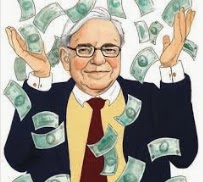
Back in May 2011 I wrote an article on this blog making the case that Berkshire Hathaway was looking cheap (Click here to see the article or go to my May 2011 folder). At the time Berkshire A shares were trading at around $120,000 and the B shares were approximately $80.

I reasoned that Berkshire looked cheap because the price-to-book value was at a historically low level (1.24). I then assumed a more realistic ratio of 1.44 and estimated an 8 percent growth in book value per share to the end of 2013 (the logic for those figures were explained in the original article).

By doing that, I arrived at a forecast year-end 2013 price of $173,000 for the A shares and $115 for the B shares.
So how did I go? Berkshire A shares as of 27 November closed at $174,625 per share and the B shares closed at $116.58.

It just goes to show that it doesn’t always take rocket science to spot a good investment opportunity.
I also added back in May 2011 that I had bought Berkshire shares using Australian dollars. At the time I purchased the Berkshire shares, the Australian dollar was worth $US1.10 (this part was just good luck). So I picked up the A shares at an effective price of around $113,000. The Australian dollar then depreciated to around $US0.92 (again, good luck).

Therefore, in Australian dollars it worked out to a 23% annual compound return over the 2.5 years. An investment in $US would have yielded closer to 15% compound per annum, not as good as my return, but still a very nice return.
I will add that I’ve now sold the shares. I don’t think Berkshire looks anywhere near as cheap today and I have plenty of algorithmic trading opportunities (which is really my bread and butter these days).

Decades ago, one could buy Berkshire at almost any price and have obtained excellent returns. Those days are long gone. Today, those kinds of returns will only have a chance of being achieved if Berkshire is bought when the price-to-book value is at a very low level.
This is a very basic, long-term mean reversion strategy - buy when price-to-book is very low and hope it reverts to the mean. Well, it worked this time. And of course, my thanks go to the US Federal Reserve for allowing it all to happen.*

I’ve commented in other articles on the legions of Buffett acolytes out there, but perhaps the best observation on this is attributable to the hedge fund manager Michael Burry (who foresaw and profited immensely from the sub-prime crisis), quoted in Michael Lewis’s brilliant book The Big Short:
“At one point I recognized that Warren Buffett, though he had every advantage from learning from Ben Graham, did not copy Ben Graham, but rather set out on his own path, and ran money his way, by his own rules. I also immediately internalised the idea that no school could teach someone how to be a great investor, if it were true, it’d be the most popular school in the world, with an impossibly high tuition. So it must not be true.”

Most people have the opposite reaction, they see what Buffett has done, it looks relatively straight forward, so they attempt to emulate him, but they can’t. And this is why I wouldn’t be giving a cent to Buffett clones, but I may have more to say on this in a future article.

 *The policies of the US Federal Reserve are either brilliant or absolutely crazy, but I can’t work out which it is    right now.